We live on a larger than normal piece of property at 10 acres and a river divides our property into two pieces. The front side of the 10 acres is nearly six acres and of that, I would guess that four acres belong to the horses, the barn, the pasture and the arena. So what does that have to do with “A Week of Starts and Stops?”
We completed the fencing and the barn in 2012. We had horses prior to 2012 but they were boarded at another barn about 15 miles away from us. My wife Kathy is the horse person in the family and several times a week she would make the 30 mile round trip to ride, take lessons , and in general, help around the barn.
We often talked about the desire (or is it a need?) to have our own barn and of course reduce the cost of boarding. So in 2011 we started planning the division of the front property and placement of the barn. I am not even going to go into all the thought and money that it takes to get it right. Just take my word – it’s a monumental task and you have no earthly idea of everything you have to think about.
So I need to cut to the chase and I will. Horses eat a lot and drink a lot. They are large animals and about 90 percent of their waking life is spent eating and eliminating. Make that 95 percent. The other five percent is walking, trotting, cantering, galloping, rolling, etc. So the point is, they make a lot of waste.
The first two years that we had the horses at our place, we spent a good deal of time forking, shoveling, and piling up the poop between the edge of the barn and the fence – so for years we moved wheelbarrows full of the stuff forty or fifty feet and dumping it. We had 2 x 12 boards serving as ramps on the ever-growing pile, so we could wheel the barrow to the top and dump. The accepted term for this collecting poop and cleaning up the stalls is “mucking.” The hills of straw (or sawdust) and poop grew from small mounds to small mountains. I have pictures somewhere and if I can find some examples I will post them.
After a while there are various grasses and weeds growing up and through the muck mountains and something had to be done. We needed a way to distribute the mucked material to the pasture where it could be turned into fertilizer and thereby actually improve the grasses that feed the horses that create the poop in the first place. This is a natural and good thing. So we bought a utility vehicle for several thousand dollars and a spreader for another $1K and started to move the mountains.
Eventually, after what seemed like a lifetime of spreading the shit all over the four acres of pasture – which at this point has been separated into thirds – for the boys, girls and a smaller area where the poop piles were once dominant – the mountains were leveled. The utility vehicle plays a most important role. Of course it has other roles – like moving bales of hay and alfalfa, but it is almost always related to the feeding (or eliminating) process.
Early this week the battery died, and our hauling and spreading effort was stopped. Our current four wheeler is a Kubota and it was built in 2007 and the battery was put into service in 2012. So that’s a good long life for a battery. I guess I have recharged it a few times over the course of the 1.5 years that we have owned it.
The Kubota RTV900 replaced our Polaris Ranger that burned up in April of 2020 – that fire is a great story for another time. – and I will write it sooner than later. Anyway, I recharged it again on Monday so we could dump the waste that continues to build every day.
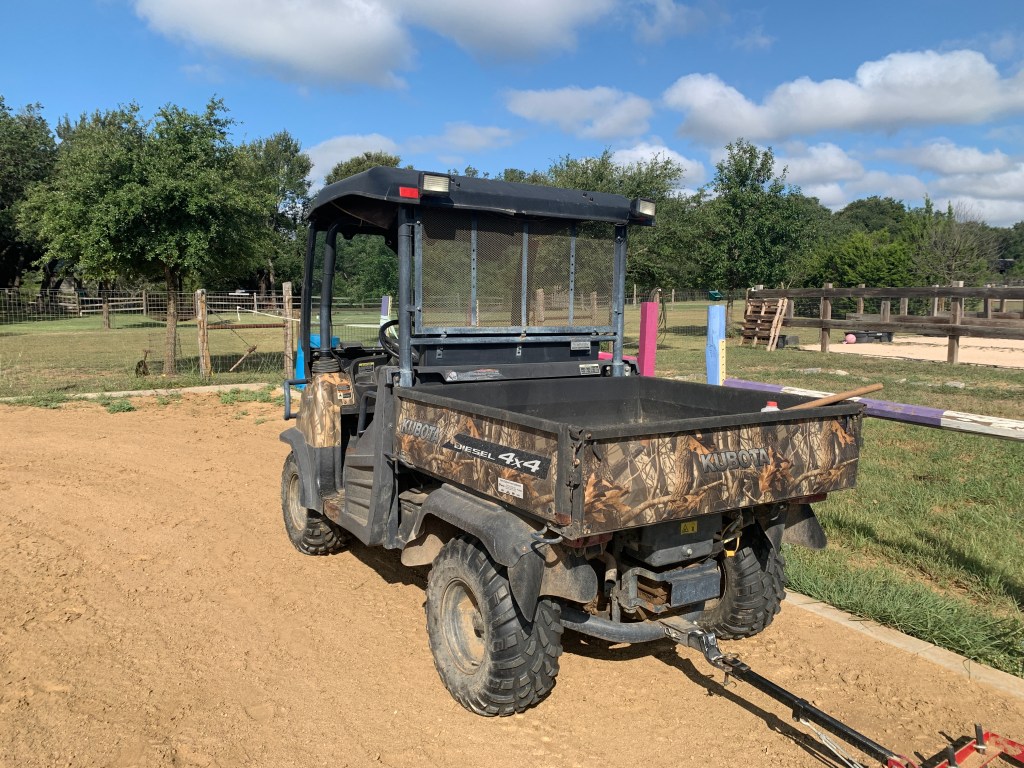
When we attempted to start the Kubota on Tuesday, the battery was dead again. So I made the trip to the dealer, Ewald Kubota in Georgetown, TX, (here is a link to their site: https://www.ewaldkubota.com/locations/georgetown) to get a new battery. Please note that the battery for a Kubota is not cheap – set me back $151 plus tax but they are good and the last a long time. I got home and started the process of changing batteries. Sounds simple enough. (At this point, I have to apologize for the length of this story – it is complicated, and I don’t want to miss any important detail.) The screws and nuts holding the battery into the battery tray had rusted – and some things broke while being removed.
After hooking up the new battery and flipping the key, nothing happened. No lights came on, nothing. I put a charger on the battery and noticed it was at 70% – it wasn’t fully charged so I left the charger on overnight. The next morning – still no lights on the dash and the started did not turn over. So, being a rational thinker I think it has to be a fuse. Thus a learning experience is about to ensue. Where is the fuse box for this thing? Oh, under the 150 pound bed, that can’t be opened because it can’t be started, and therefore the hydraulic lift that makes it easy, can’t be used. More research. After some reading I learn that you can float the bed, and lift it manually, Did you see the part about the weight of this thing.? Anyway we found the fuse box. So there are two master fuses, 50 amp and 60 amp and I decide it must be one of those.
Off to the dealer again – they are starting to recognize me and now know that I might be interested in buying a new utility vehicle to replace my 14 year old diesel engine equipped essential piece of gear. Hold that thought, we will come back to it at some point, but probably not today.
So I buy fuses and also some other hardware – like nuts to attach the battery tie downs to the holder and the mounting bar – oh, also one of the tie downs because I could not get the rusted and now permanent nuts off the old tie down rod (or whatever the Japanese manufacturer might call that piece). Another $40 invested in the ability to move mountains of – you get it.
Yesterday, after replacing the fuses, and trying again – now that the battery was fully charged – there were still no lights, and no start. Josh, our son, was helping me, because I clearly need and appreciate the help. Scratching our heads we (finally) come to the conclusion that we must have missed something. So we start looking for loose or cut wires, etc. That’s when we spot a wire cable up against the frame of the Kubota – it’s a tight area and it looked like the cable was attached to the frame – perhaps a ground wire. But wait – it isn’t attached. There is a clip at the end of the wire and it has a hole in it. OMG, the missing link is right there staring us in the face.
Quickly we attach the wire to the positive terminal of the battery and lo and behold, the Kubota lights up and starts faster than it has ever started. We almost cheered but you have to watch that self-congratulation stuff. Let’s just say that we were very happy – and so was Kathy!
I was able to drive and dump last night and we are all feeling pretty good today after this week of living and learning. Sometimes it’s the small things that mean the most. Hope y’all are having a good week I will be back soon with another story from the river’s edge.


I didn’t know you were such a great writer Dave! Great tail ( pun intended)
LikeLiked by 1 person
Fortunately, here in Mexico we trade manure to the brick makers for bricks.
LikeLiked by 1 person
That’s awesome. Wish we had that process here.
LikeLike
Great story and I can commiserate with you pain!!
LikeLiked by 1 person